ABOUT USSustainability
Sustainability Approach
Board Statement
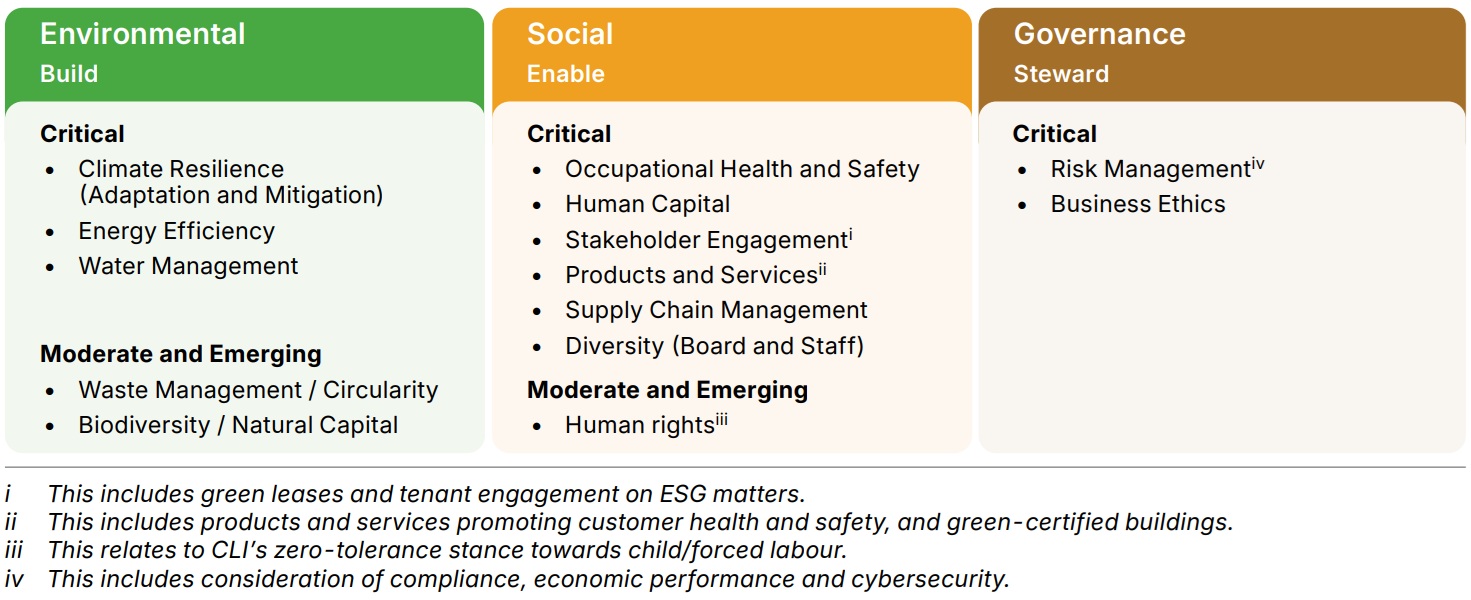
CLCT is committed to growing in a responsible manner, delivering long-term economic value, and contributing to the environmental and social well-being of our communities. The material Environmental, Social and Governance (ESG) factors have been identified and encapsulated in the CapitaLand Investment 2030 Sustainability Master Plan (SMP).
The CLI 2030 SMP steers our efforts on a common course to maximise impact through building portfolio resilience and resource efficiency, enabling thriving and future-adaptive communities, and stewarding responsible business conduct and governance.
The CLCT Board is responsible for overseeing the REIT’s sustainability efforts, and considers ESG factors in determining its strategic direction and priorities. The CLCT Board also approves the executive compensation framework based on the principle of linking pay to performance. CLCT’s business plans are translated to both quantitative and qualitative performance targets, including sustainable corporate practices and are cascaded throughout the REIT.
Sustainability Commitment
CapitaLand China Trust commits to CLI 2030 SMP goals and targets.
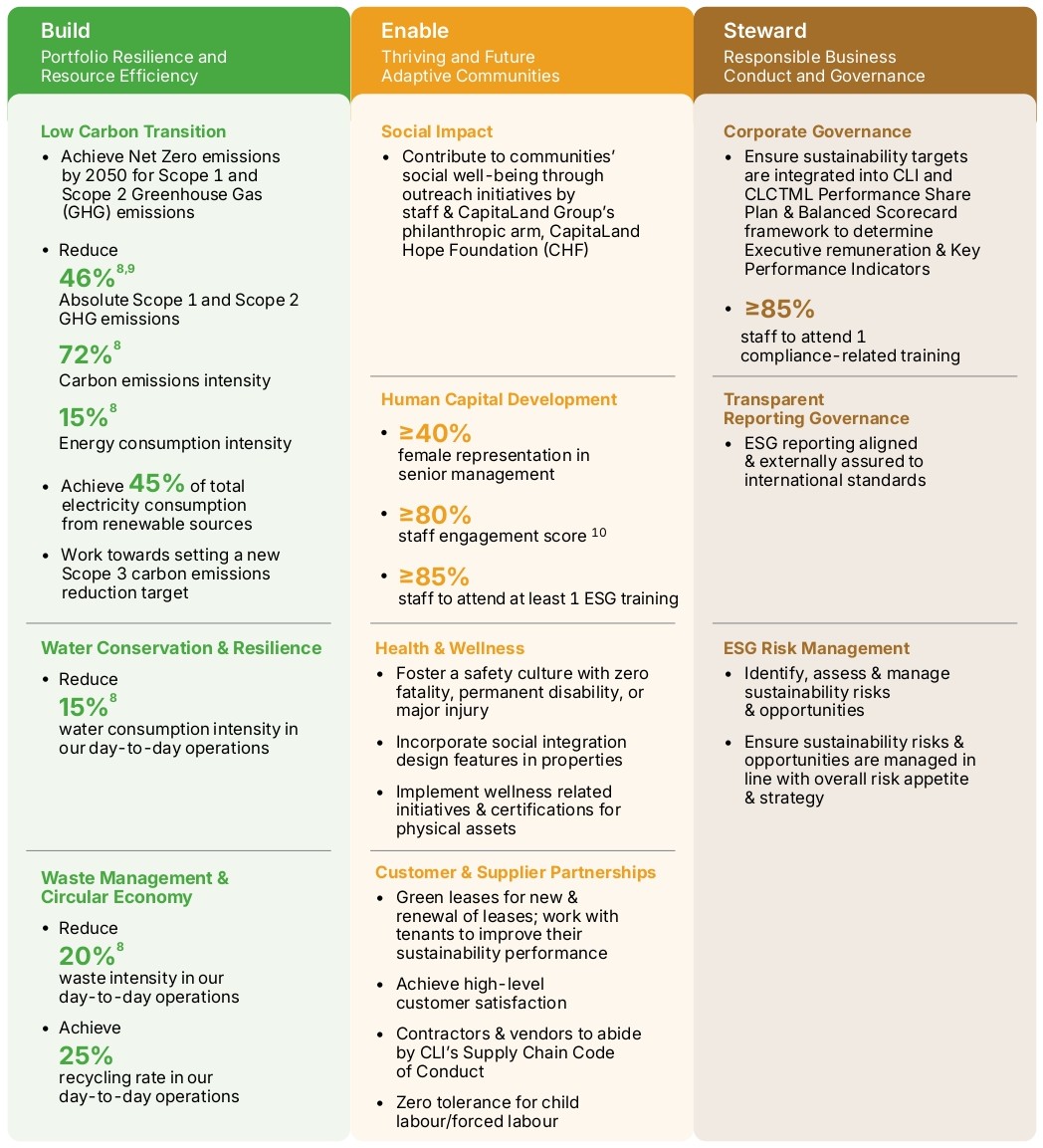
Note: Enable & Steward targets are intended to reflect the organisation-wide goals set by CLI on a Group basis, and are intended to be implemented subject to and taking into account (i) fair & equitable employment practices and principles under applicable laws and market practice and (ii) the business and operational needs of the Company and the organisation, as applicable.
8 Using 2019 as the baseline year.
9 This refers to gross greenhouse gas emissions. For more information on greenhouse gases covered by this target, please refer
to the GHG Emissions Data Methodology.
10 Employee engagement score of at least 80% (with at least 85% participation).
Sustainability Governance
Responsible Business Conduct
CLCT is committed to promoting respect for human rights and proactively addressing human rights issues that may affect the REIT’s activities, in accordance with CLI’s policies and commitments. These policy commitments are endorsed by the Boards and management of both CLI and CLCTML and are integrated into CLCT’s operations and business relationships.
CLCT adopts CLI’s Social Charter to uphold human dignity and self-respect. This charter applies to our workforce and supply chain, covering human rights, child labour, forced labour, human trafficking, code of conduct, diversity and inclusion, and promoting a healthy work-life balance.
Additional human rights commitments, such as grievance procedures, anti-harassment policies, and remedial measures, are implemented across various levels of the organisation.
-
Strategic Sustainability Management Structure


-
Board, Top Management and Employee Commitment


Strategic Sustainability Management Structure
Board, Top Management and Staff Commitment and Involvement
Role of Sponsor’s Board, Management and Employees
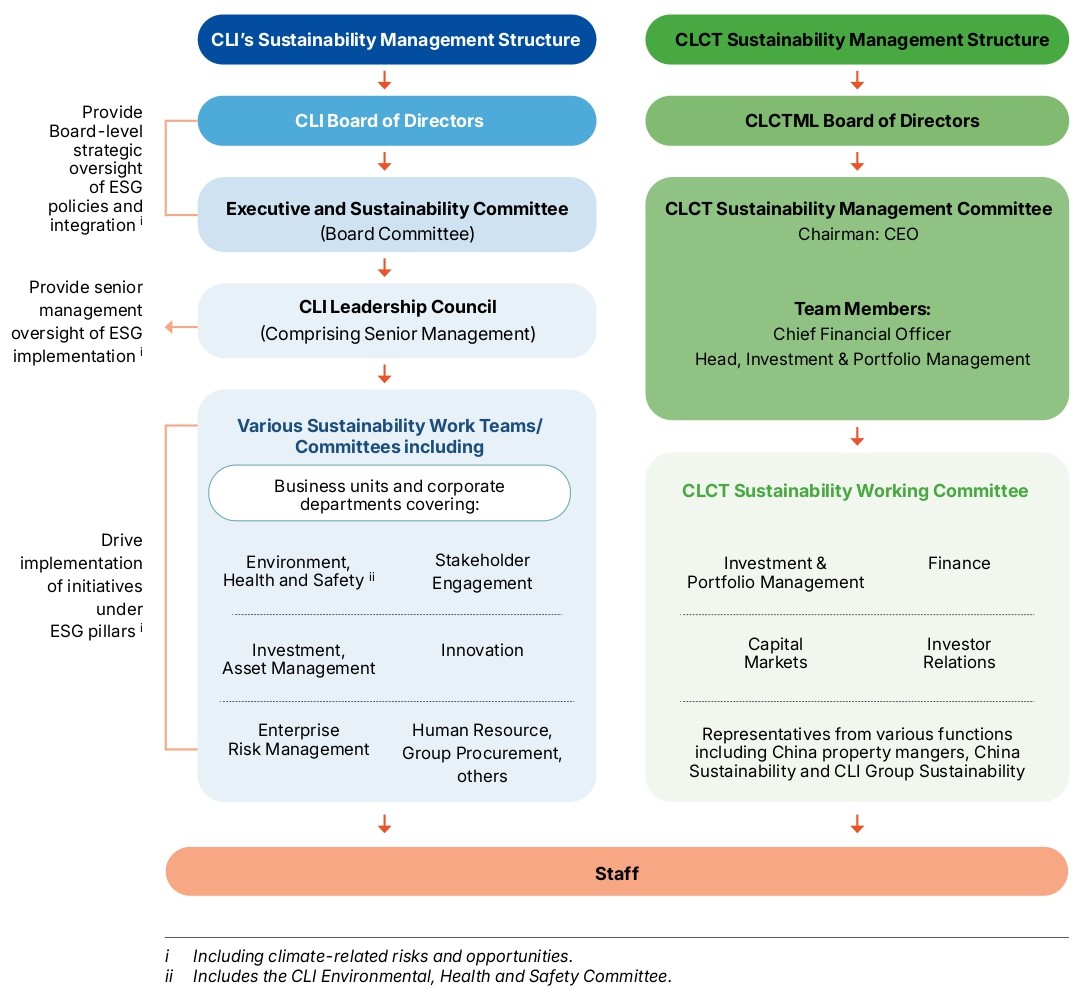
The Sponsor’s (CLI) Board recognises the importance of sustainability as a business imperative and ensures that sustainability considerations, including climate-related ones, are factored into CLI’s strategy development. This enables CLI to remain competitive and resilient in an increasingly challenging business environment.
The CLI Board is kept informed on a regular basis through its Executive and Sustainability Committee (ESC)11 on CLI Group’s sustainability management performance, key material issues12 identified by stakeholders, and the planned follow-up measures. The CLI Board is updated by the Risk Committee and Audit Committee at least once a year. The CLI Board discusses matters relating to sustainability and climate-related risks, and relevant performance metrics, which include CLI Group’s progress on achieving the carbon emissions reduction targets, green building certifications, human capital development, stakeholders’ expectations on climate change, social impact and/or other matters. The CLI Board is also informed of any incidents relating to workplace safety, business malpractice, and environmental impact, which may include climate-related damage or disruptions. IFRS S2 6(a)(ii), 6(a)(v)
CLI Group’s Chairman also chairs the ESC, which is a Board Committee. This committee is responsible for overseeing CLI Group’s sustainability and climate strategies, including providing guidance to management and monitoring progress against achieving the goals of CLI Group’s sustainability initiatives. The CLI Group’s sustainability targets12 are reviewed and approved by the ESC and Board. The ESC is scheduled to meet on a quarterly basis. The ESC’s responsibilities12 are set out in the Board Committees’ role descriptions in CLI’s Corporate Governance Report. For more information, please refer to the CLI’s AR 2025 on Board Committees. IFRS S2 6(a)
The CLI Leadership Council makes strategic resource allocation decisions and meets on a regular basis. The CLI Leadership Council comprises the CLI Group Chief Executive Officer (CEO), the CEOs of the various business units, and key management executives of the corporate office.
The sustainability work teams comprise representatives from CLI’s business units and corporate functions. Each business unit has its own Environmental, Health, and Safety (EHS) Committee to drive initiatives in the countries where it operates, with support from various departments.
Role of CLCTML Board, Management and Employees
The CLCTML Board of Directors holds ultimate responsibility for managing CLCT’s sustainability risks and opportunities, including the integration of sustainability and climate-related considerations into the business strategy. The Board keeps itself abreast of the latest sustainability and industry developments and continuously upskills itself with respect to sustainability and climate-related issues. Board members have participated in sustainability training as mandated by SGX, and all new and existing Board members are briefed on the CLI 2030 SMP, sustainability management at CLCT, and climate-related matters. Please refer to CLCT’s AR 2025 on page 58 for more information on Board Orientation and Training. IFRS S2 6(a)(ii)
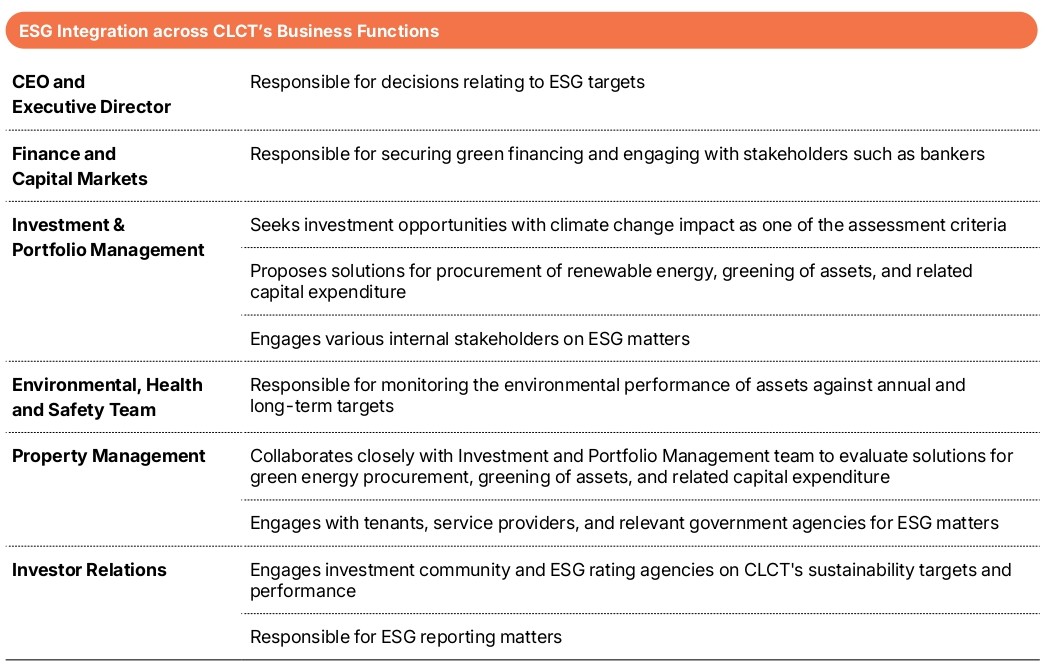
CLCT has established a Sustainability Management Committee (SMC), chaired by the CEO of the REIT Manager, that meets biannually to focus on sustainability and climate-related matters. The SMC, comprising senior management, oversees sustainability objectives and strategies and provides semi-annual updates to the Board of Directors on the value and mission statements, goals, strategies, overviews, policies and progress related to sustainable development and climate resilience. IFRS S2 6(a)(iii), 6(a)(v), 6(b)(i), 6(b)(ii)
The SMC is supported by CLCT’s Sustainability Working Committee (SWC), which comprises key members from various business functions, to implement sustainability and climate-related initiatives across CLCT’s operations in line with CLI’s sustainability framework and policies. CLCT’s sustainability governance aligns with the Sponsor’s sustainability management. CLCT is represented at the CLI Senior Leadership Council by the CEO of the REIT Manager of CLCT, who guides sustainability strategies and goals for CLCT. The SWC convenes quarterly to discuss sustainability strategies and operational implementation. IFRS S2 6(b)(i), 6(b)(ii)
The content of this Report, including material ESG topics, is reviewed and approved by the CLCTML Board of Directors, which also discusses and reviews sustainability policies and strategies during its meetings.
CLCT’s SWC collaborates closely with CLI’s EHS Committee to implement sustainability-related initiatives across its operations. In addition to environmental and climate-related initiatives, CLI also champions Occupational Health and Safety (OHS) with commitment from the top management and employee participation through an integrated EHS Management System, as well as stakeholder engagement activities. CLCTML’s CEO is accountable for the EHS performance of CLCT. Employees are encouraged to be forthcoming in reporting both environmental-related issues and OHS-related incidents, including non-compliances and non-conformities.
Key Performance Indicators (KPIs) Tied to Remuneration
The remuneration for all employees in the REIT Manager, including top management, is linked to CLCT’s environmental targets through KPIs. CLCT aims to minimise environmental impacts by setting targets for green building ratings, carbon emissions, energy, water, and waste reduction. IFRS S2 29(g)(i)
Beyond environmental KPIs, CLCT also integrates OHS KPIs with the remuneration of all CLCT employees, including its top management. These targets are tied to the remuneration of top management and employees.
Further information on this can be accessed in the Environmental and Social chapter of this Report.
11 The Executive Committee and the Strategy and Sustainability Committee merged with effect from 1 January 2025, to form the
Executive and Sustainability Committee.
12 This includes those related to climate-related risks and opportunities.